Tocqueville between Two Worlds: The Making of a Political and Theoretical Life by Sheldon S. Wolin
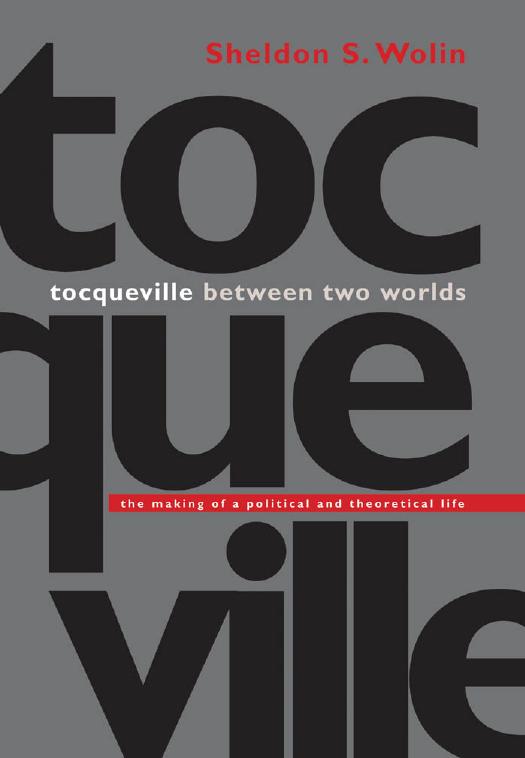
Author:Sheldon S. Wolin [Wolin, Sheldon S.]
Language: eng
Format: epub, pdf
Publisher: Princeton University Press
Published: 2009-02-09T07:00:00+00:00
CHAPTER XVII
DESPOTISM AND UTOPIA
I
What then is the majority, taken collectively, except an individual who has opinions and more often interests contrary to those of another individual, called the minority? . . . My strongest reproach to democratic government, such as it has been organized in the United States, is not . . . its weakness, but its irresistible force. What I find most repugnant about America is not the extreme freedom which rules there, but the few guarantees against tyranny.
Tocqueville1
If “political” or “communal liberty” was the great discovery of the first volume of Democracy in America, the theory of modern despotism was perhaps a greater theoretical achievement: the intimation of a postdemocratic “beyond” that did not yet exist.2 In the first volume Tocqueville had raised the possibility that despotism might emerge from American democracy, that is, grow naturally out of it rather than be imposed on it. The unlimited discretion that Americans allowed their elected magistrates might enable one of them to exploit the dogma of the unlimited authority of the people to establish despotic rule.3
When Tocqueville resumed the discussion of despotism in volume 2 he did not cast it as a response to the breakdown of institutions, or to a crisis that provoked a demand for a “strong man”; or to the emergence of a charismatic leader, such as Andrew Jackson.4 In fact, despotism did not represent a specific response but a configuration resulting from certain tendencies in the symbolic life of democracy and their cultural repercussions in the psychic lives of individuals. To grasp it required the equivalent of a conceptual revolution.
In one of the last chapters of the second volume, “What Type of Despotism Democratic Nations Have to Fear,” he remarks that although he had recognized in volume 1 that a democratic social condition furnished a potentially fertile ground for despotism, he had assumed that the despotism would be similar to the kind of “oppression” that had weighed upon “several of the peoples of antiquity.” Now, however, “after five years of new meditations, my fears have not at all diminished but their object has changed.”5 Tyranny remained the most pressing danger but it did not lay in the potential excesses of majority rule or in the threat of a new-style democratic Caesar: “the type of oppression which threatens democratic peoples has no precedent; our contemporaries will find no image of it in their memories. I myself have vainly sought for the expression which would exactly capture the conception I have formed.”6
Why was it difficult to name despotism? Over the centuries political theorists and historians had not been at a loss in describing or agreeing about the characteristics of despotism.7 The despot gathered all power to himself; would not tolerate rivals; eliminated political life; ruled by personal whim; lived extravagantly while demoralizing economic life; and, as Montesquieu emphasized, used cruelty to create a climate of fear that paralyzed opposition and stifled cultural creativity. These conceptions were all inconceivable without the dominating figure of the despot himself. The state of society was a projection of him.
Download
Tocqueville between Two Worlds: The Making of a Political and Theoretical Life by Sheldon S. Wolin.pdf
This site does not store any files on its server. We only index and link to content provided by other sites. Please contact the content providers to delete copyright contents if any and email us, we'll remove relevant links or contents immediately.
| Anthropology | Archaeology |
| Philosophy | Politics & Government |
| Social Sciences | Sociology |
| Women's Studies |
The Secret History by Donna Tartt(19469)
The Social Justice Warrior Handbook by Lisa De Pasquale(12293)
Thirteen Reasons Why by Jay Asher(9118)
This Is How You Lose Her by Junot Diaz(7056)
Weapons of Math Destruction by Cathy O'Neil(6466)
Zero to One by Peter Thiel(5951)
Beartown by Fredrik Backman(5937)
The Myth of the Strong Leader by Archie Brown(5623)
The Fire Next Time by James Baldwin(5582)
How Democracies Die by Steven Levitsky & Daniel Ziblatt(5322)
Promise Me, Dad by Joe Biden(5229)
Stone's Rules by Roger Stone(5189)
A Higher Loyalty: Truth, Lies, and Leadership by James Comey(5087)
100 Deadly Skills by Clint Emerson(5023)
Rise and Kill First by Ronen Bergman(4890)
Secrecy World by Jake Bernstein(4878)
The David Icke Guide to the Global Conspiracy (and how to end it) by David Icke(4850)
The Doomsday Machine by Daniel Ellsberg(4619)
The Farm by Tom Rob Smith(4611)
